

What Are The Three Ways Island Groups Can Be Divided? Describe Or Draw A Picture Of Each Below
Oceania is a region made up of thousands of islands throughout the Central and South Pacific Ocean. It includes Australia, the smallest continent in terms of full land area. Near of Commonwealth of australia and Oceania is under the Pacific, a vast body of water that is larger than all the Earth's continental landmasses and islands combined. The name "Oceania" justly establishes the Pacific Bounding main equally the defining characteristic of the continent. Oceania is dominated past the nation of Commonwealth of australia. The other two major landmasses of Oceania are the microcontinent of Zealandia, which includes the country of New Zealand, and the eastern half of the island of New Guinea, made upward of the nation of Papua New Republic of guinea. Oceania also includes iii isle regions: Melanesia, Micronesia, and Polynesia (including the U.S. state of Hawaii). Oceania'due south physical geography, environment and resources, and human geography tin can be considered separately. Oceania can be divided into iii island groups: continental islands, high islands, and depression islands. The islands in each grouping are formed in unlike ways and are made up of different materials. Continental islands have a diverseness of physical features, while high and depression islands are adequately compatible in their physical geography. Continental Islands Continental islands were once attached to continents before body of water level changes and tectonic activity isolated them. Tectonic activity refers to the movement and collision of different sections, or plates, of the Earth'south crust. Australia, Zealandia, and New Guinea are continental islands. These three regions share some physical features. All three accept mountain ranges or highlands—the Great Dividing Range in Australia; the North Island Volcanic Plateau and Southern Alps in New Zealand; and the New Republic of guinea Highlands in Papua New Guinea. These highlands are fold mountains, created equally tectonic plates pressed together and pushed land upward. New Zealand and Papua New Guinea also have volcanic features as a result of tectonic activity. Although they share some landscape features, each of these regions has distinct physical features that resulted from different ecology processes. Commonwealth of australia'south landscape is dominated by the Outback, a region of deserts and semi-barren country. The Outback is a outcome of the continent's large inland plains, its location forth the dry Tropic of Capricorn, and its proximity to cool, dry, southerly winds. New Zealand'southward glaciers are a result of the islands' high elevations and proximity to absurd, moisture-bearing winds. Papua New Guinea'south highland rain forests are a effect of the island's high elevations, proximity to tropical, moisture-bearing winds, and location right below the warm Equator. High Islands High islands, as well chosen volcanic islands, are created as volcanic eruptions build up land over time. These eruptions begin under water, when hot magma is cooled and hardened by the sea. Over time, this activity creates islands with a steep central pinnacle—hence the name "high island." Ridges and valleys radiate outward from the peak toward the coastline. The island region of Melanesia contains many high islands because it is a major part of the "Band of Fire," a string of volcanoes effectually the boundary of the Pacific Ocean. This part of the Ring of Fire is on the boundary of the Pacific plate and the Australian plate. This is a convergent plate boundary, where the ii plates movement toward each other. Important volcanic mountains in Melanesia include Mount Tomanivi, Republic of the fiji islands; Mount Lamington, Papua New Guinea; and Mountain Yasur, Vanuatu. Depression Islands Low islands are likewise chosen coral islands. They are made of the skeletons and living bodies of small marine animals called corals. Sometimes, coral islands barely reach in a higher place sea level—hence the name "depression isle." Low islands often take the shape of an irregular ring of very minor islands, called an atoll, surrounding a lagoon. An atoll forms when a coral reef builds up around a volcanic island, then the volcanic island erodes away, leaving a lagoon. Atolls are divers equally 1 island even though they are made up of multiple communities of coral. The island regions of Micronesia and Polynesia are dominated by low islands. The Kwajalein Atoll in the Marshall islands, for example, is composed of 97 islands and islets that environment one of the largest lagoons in the world, with an surface area of two,173 square kilometers (839 foursquare miles). The nation of Republic of kiribati is composed of 32 atolls and one solitary isle dispersed over 3.5 1000000 square kilometers (i.35 million square miles) of the Pacific Ocean. Island Flora and Fauna The development of flora and fauna beyond the islands of Australia and Oceania is unique. Many plants and animals reached the islands from south asia during the last glacial period, when bounding main levels were depression plenty to let for travel. Later on sea levels rose, species adapted to the surroundings of each island or community of islands, producing multiple species that evolved from a common ancestor. Due to its isolation from the rest of the world, Commonwealth of australia and Oceania has an incredibly loftier number of endemic species, or species that are constitute nowhere else on Globe. Plants traveled betwixt islands past riding wind or ocean currents. Birds carried the seeds of fruits and plants and spread them between islands with their droppings. Ferns, mosses, and some flowering plants rely on spores or seeds that can remain airborne for long distances. Coconut palms and mangroves, common throughout Australia and Oceania, produce seeds that can float on salty water for weeks at a time. Of import flowering plants native to Australia and Oceania include the jacaranda, hibiscus, pohutukawa, and kowhai. Other indigenous trees include the breadfruit, eucalyptus, and banyan. Birds are very common in Australia and Oceania because they are 1 of the few animals mobile enough to motility from island to isle. There are more than 110 endemic bird species in Commonwealth of australia and Oceania, including many seabirds. Many flightless birds, such as emus, kiwis, cassowaries, wekas, and takahes, are native to Australia, Papua New Guinea, and New Zealand. The Pacific Islands take more than 25 species of birds of paradise, which showroom colorful feather. Lizards and bats make up the bulk of Australia and Oceania'south native land animals. Lizard species include the goanna, skink, and bearded dragon. Commonwealth of australia and Oceania has more than a hundred different species of fruit bats. The few native land animals in Commonwealth of australia and Oceania are unusual. Australia and Oceania is the just place in the world that is dwelling house to monotremes—mammals that lay eggs. All monotremes are native to Australia and Papua New Guinea. There are only five living species: the duckbill platypus and 4 species of echidna. Many of the most familiar animals native to Commonwealth of australia and Oceania are marsupials, including the koala, kangaroo, and wallaby. Marsupials are mammals that behave their newborn young in a pouch. Virtually 70 percent of the marsupials on Earth are native to Oceania. (The remainder are native to the Americas.) In Australia and Oceania, marsupials did not confront threats or competition from large predators such as lions, tigers, or bears. The red kangaroo, the globe'due south largest marsupial, can abound up to two meters (half-dozen feet) tall, and weigh equally much as 100 kilograms (220 pounds). In the Americas, marsupials such as possums are much smaller. Marine Flora and Fauna The marine environment is an important and influential concrete region in Commonwealth of australia and Oceania. The region is equanimous of iii marine realms: Temperate Australasia, Fundamental Indo-Pacific, and Eastern Indo-Pacific. Marine realms are large ocean regions where animal and found life are similar because of shared environmental and evolutionary factors. The Temperate Australasia realm includes the seas surrounding the southern half of Commonwealth of australia and the islands of New Zealand. This realm is i of the earth's richest areas for seabirds. Its common cold, nutrient-rich waters support a diverseness of plants and fish that seabirds feed on. These seabirds include different species of albatross, petrel, and shearwater, also equally the Australasian gannet and rockhopper penguin. The Central Indo-Pacific realm includes the seas surrounding the northern half of Australia, Papua New Republic of guinea, Solomon Islands, Vanuatu, New Caledonia, Republic of the fiji islands, and Tonga. This marine realm has the greatest diversity of tropical coral in the world and includes the world'south two largest coral formations: Commonwealth of australia's Great Barrier Reef and the New Caledonia Barrier Reef. The Great Barrier Reef, a UNESCO World Heritage Site off the declension of northeast Commonwealth of australia, is 344,400 square kilometers (133,000 square miles). The Peachy Barrier Reef and the New Caledonia Bulwark Reef are underwater hotspots for biodiversity. The Cracking Barrier Reef is habitation to xxx species of whales, dolphins, and porpoises; six species of sea turtles; 215 species of birds; and more than 1,500 species of fish. The New Caledonia Bulwark Reef is domicile to 600 species of sponges, 5,500 species of mollusks, v,000 species of crustaceans, and at least one,000 species of fish. The Eastern Indo-Pacific realm surrounds the tropical islands of the key Pacific Ocean, extending from the Marshall islands through central and southeastern Polynesia. Like the Key Indo-Pacific realm, this realm is as well known for its tropical coral formations. A variety of whale, tortoise, and fish species also inhabit this realm.
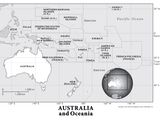
Australia and Oceania is a continent fabricated up of thousands of islands throughout the South Pacific Body of water.
Map by the National Geographic Society
Most Renewable Electricity Produced
New Zealand (73%; hydropower, geothermal, wind, biomass)
Population Density
8 people per square kilometer
Largest Watershed
Murray-Darling river system (i million foursquare kilometers/409,835 square miles)
Highest Acme
Mountain Kosciuszko, Australia (2,228 meters/seven,310 feet)
Largest Urban Surface area
Sydney, Australia (iv million people)
ancestor
Noun
organism from whom one is descended.
Noun
a coral reef or string of coral islands that surrounds a lagoon.
Noun
all the unlike kinds of living organisms inside a given area.
Noun
one of the seven main land masses on Globe.
continental island
Noun
land once connected to a continent but broken off past shifting tectonic plates.
convergent plate boundary
Substantive
area where two or more than tectonic plates bump into each other. Also called a collision zone.
Noun
tiny ocean animal, some of which secrete calcium carbonate to form reefs.
coral reef
Noun
rocky sea features fabricated up of millions of coral skeletons.
Substantive
rocky outermost layer of Earth or other planet.
Noun
steady, predictable flow of fluid inside a larger torso of that fluid.
Noun
expanse of land that receives no more 25 centimeters (10 inches) of atmospheric precipitation a twelvemonth.
Substantive
tiptop above or below body of water level.
owned
Adjective
native to a specific geographic space.
surround
Substantive
conditions that surround and influence an organism or community.
Substantive
imaginary line around the Globe, another planet, or star running due east-west, 0 degrees latitude.
evolution
Noun
change in heritable traits of a population over fourth dimension.
fauna
Substantive
animals associated with an surface area or time period.
flora
Noun
plants associated with an area or time period.
Substantive
areas of the Globe's crust that have been aptitude and forced upwardly past movement of tectonic plates.
glacial period
Substantive
time of long-term lowering of temperatures on World. Also known as an water ice age.
Noun
mass of ice that moves slowly over land.
high island
Noun
an oceanic or volcanic island.
human geography
Noun
the study of the style human communities and systems interact with their environment.
Noun
body of country surrounded by water.
Noun
shallow torso of water that may have an opening to a larger body of h2o, but is also protected from information technology by a sandbar or coral reef.
Noun
the geographic features of a region.
low isle
Noun
continental island.
Noun
molten, or partially melted, rock below the Earth's surface.
marine
Describing word
having to do with the ocean.
marine realm
Substantive
large ocean region, including its underwater landscape, climate, and organisms.
marsupial
Noun
mammal that carries its young in a pouch on the mother'south body.
microcontinent
Substantive
a blazon of large continental island.
monotreme
Noun
blazon of mammals that lay eggs instead of giving birth to live young.
mountain range
Noun
series or chain of mountains that are close together.
Substantive
substance an organism needs for energy, growth, and life.
Oceania
Noun
region including island groups in the Due south Pacific.
Outback
Noun
remote, sparsely populated interior region of Commonwealth of australia.
concrete geography
Noun
study of the natural features and processes of the Earth.
Substantive
flat, smooth area at a low superlative.
predator
Substantive
animal that hunts other animals for food.
Noun
area of tall, mostly evergreen trees and a high amount of rainfall.
resource
Noun
available supply of materials, goods, or services. Resources can be natural or homo.
Noun
horseshoe-shaped string of volcanoes and earthquake sites around edges of the Pacific Body of water.
Noun
base of operations level for measuring elevations. Sea level is determined by measurements taken over a nineteen-year cycle.
tectonic activity
Substantive
movement of tectonic plates resulting in geologic activity such every bit volcanic eruptions and earthquakes.
tropical
Describing word
existing in the tropics, the latitudes between the Tropic of Cancer in the north and the Tropic of Capricorn in the south.
Substantive
the United nations Educational, Scientific, and Cultural Organization.
unique
Adjective
one of a kind.
valley
Substantive
depression in the Earth between hills.
Substantive
an opening in the Globe's crust, through which lava, ash, and gases erupt, and besides the cone congenital by eruptions.
Noun
a microcontinent that broke off from Commonwealth of australia about eighty million years ago. Zealandia is almost totally underwater.

Source: https://www.nationalgeographic.org/encyclopedia/oceania-physical-geography/
Posted by: davisgostain.blogspot.com
0 Response to "What Are The Three Ways Island Groups Can Be Divided? Describe Or Draw A Picture Of Each Below"
Post a Comment