

Do I Draw A Tile When I Enter The Morder Track

A choice of Rummikub tiles and racks.
Rummikub ()[1] is a tile-based game for two to iv players, combining elements of the carte du jour game rummy and mahjong. There are 106 tiles in the game, including 104 numbered tiles (valued ane to 13 in 4 different colors, two copies of each) and two jokers. Players have 14 or 16 tiles initially and take turns putting down tiles from their racks into sets (groups or runs) of at least iii, drawing a tile if they cannot play. In the Sabra version (the nigh common and pop), the first thespian to use all their tiles scores a positive score based on the full of the other players' hands, while the losers get negative scores. An of import feature of the game is that players can work with the tiles that have already been played.
History [edit]
Rummikub was invented by Ephraim Hertzano, a Romanian-born Jew, who immigrated to Palestine in the 1940s. He hand-made the commencement sets with his family in the backyard of his home. Hertzano sold these sets door-to-door and on a consignment basis at small shops. Over the years, the family licensed it to other countries and information technology became Israel's best selling export game. In 1977, it became a bestselling game in the U.s..[2] [3] The game was marketed as "Rummikid" during part of the 1970s.[iv]
Hertzano's Official Rummikub Book, published in 1978, describes three unlike versions of the game: American, Sabra, and International. Mod Rummikub sets include only the Sabra version rules, with no mention of the others, and at that place are variations in the rules betwixt publishers. The game was first made by Lemada Lite Industries Ltd, founded by Hertzano in 1978.
Rummikub is similar to several central European card games which are played with 2 decks of playing cards, including Machiavelli and Vatikan. Vatikan is played with ii decks of cards and one joker per player, thus making 106 cards for two players.[v]
In Turkey, the game is known as okey and is widely played by families at gatherings or at local cafes, usually accompanied by black Turkish tea, Turkish coffee and sometimes hookah.
Game pieces [edit]

Rummikub'southward main component is a pool of tiles, consisting of 104 number tiles and two joker tiles. The number tiles range in value from one to thirteen in four colors (blue, red, yellow,[six] and black). Each combination of colour and number is represented twice. Players each have a rack to store tiles without revealing the confront of the tiles to the other role player.
Rules [edit]
The post-obit explanation is based on the rules in the 1998 Pressman American edition:
Setup [edit]
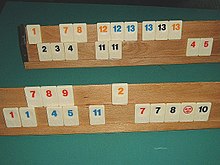
The racks of two players.
Tiles are shuffled together and either placed into a handbag or spread out face down beyond the table. Each role player draws and reveals 1 tile. The role player whose tile has the highest number value volition beginning the game. Tiles are returned to the pool, and players collect 14 random tiles and suit them on their racks. Play begins with the starting player and proceeds in a clockwise (for modern variants) direction.
Play [edit]
For the beginning actor's motility, they must play a set (or sets in some versions) with a value of at least thirty points. Signal values are taken from the face value of each tile played, with the joker (if played) assuming the value of the tile information technology is being used in place of. A histrion may not use other players' tiles to make the "initial meld". If a histrion cannot make an initial meld, they must pick up a single tile from the pool and add together it to their rack. Play so proceeds to the next player.
Once a player has fabricated their initial meld, they tin, on a separate plough, play 1 or more tiles from their rack, making or adding to groups and/or runs. If the player cannot (or chooses not to) play any tiles, they must pick a tile randomly from the puddle and add together information technology to their rack.
Players may not make their initial meld and along with that play on groups and runs during the aforementioned turn. You tin play on runs and groups after the turn of making the initial meld.
Players may play tiles by amending sets already in play. The only limit to the length of a run is the extremes of the tile values. Groups are limited to 4 considering colors may not repeat within a grouping.
Sets [edit]
All tiles in play must exist arranged in sets of at least three tiles. The two valid set types are called runs and groups.
A run is composed of 3 or more than, aforementioned-colored tiles, in sequent number guild. (A one may not follow a 13.)
A grouping is made from iii or four same-value tiles in distinct colors. For example: red 3, blue 3, black iii and yellow 3.
Examples of invalid sets [edit]
-
Invalid because numbers are not consecutive: 1
2
4
Invalid considering numbers in a run must all be the aforementioned color: ane
two
3
Invalid because colors may not repeat in a group (but house rules may permit this): 1
1
i
Example of play [edit]
-
Tiles already out-played: 3
4
5
Own tiles: 2
5
5
Recombined consequence: 2
3
iv
and5
5
5
Manipulating existing tiles [edit]
During a player's turn, sets of tiles that take already been played may exist manipulated to let more than tiles to be played. At the stop of the turn, all played tiles must be in valid sets.
- Shifting a run
- Players may add the advisable tile to either terminate of a run and remove a tile from the other end for apply elsewhere. If red three, iv, and five take already been played, a actor may add the red 6 to the end and remove the 3 for use elsewhere.
- Splitting a run
- Players may carve up long runs and insert the respective tiles in the eye. Thus, if blue 6, seven, 8, ix, and 10 are already a run, the actor may insert his own 8 to make two runs: 6, vii, eight and eight, 9, x.
- Substituting in a grouping
- Players may supplant whatsoever of the tiles in a three-tile group with a tile of the 4th color and the same value. If blue half-dozen, red 6, and xanthous 6 are already a group, the histrion may add the black 6 and remove any i of the other 3 for use elsewhere.
- Removing tiles
- So long as the remaining tiles form a valid run, tiles tin can be removed from the ends of runs. Any i tile may exist removed from a four-tile group.
- Joker exchange
- A joker may be retrieved before the initial meld. A joker can be retrieved from a set by replacing it with a tile of the same numerical value and colour it represents. The tile used to supercede the joker can come up from the player'southward rack or from the table. In the case of a group of 3, the joker can be replaced by the tile of either of the missing colours. A joker that has been replaced must be used in the role player's aforementioned plough as role of a new prepare. A set up containing a joker can accept tiles added to information technology, exist separate apart or have tiles removed from it. The joker can be moved or replaced in whatever possible way every bit long as you maintain a prepare of at least iii tiles. The joker has a penalty value of 30 points if it remains on a player'due south rack at the end of the game[7]
- Harvested tiles
- In the course of a plough, a tile that is "harvested" from an existing ready must be played during the plough; it cannot be kept for later use. Example: if there is a 3, iv, five run on the table, the three can exist harvested past putting downward the accordingly colored 6, but the 3 must be used during that plow, not kept in the player's hand for later utilise.
Scoring [edit]
In one case a winner has been declared, the losing players must add together upwards the values of the tiles remaining in their racks (their score for the game). The joker has a penalty value of 30. A role player'southward score for the game is subtracted from his current cumulative score. Once calculated, each of the losing players' scores for the game is added to the winners current cumulative score.
For example- suppose in a game player A wins, player B has a score of v, player C has a score of ten and thespian D a score of 3. Player A will now have a cumulative score of 18, role player B will be −5, histrion C will exist −10 and player D will be −3.
Should the game result in no winner, the player with the lowest number of tiles in their rack is the winner. Scoring is then carried out in the normal manner.
If one person never had the required points to brand a meld and the game is over, their points are added to the score of each of the other players. The person with the fewest points is the winner.
Winning [edit]
Game play continues until a thespian has used all of the tiles in the rack, at which indicate they should call out "Rummikub," and are declared the winner. If the puddle runs out of tiles, play continues until there is a winner or no player can brand a valid play.
Awards [edit]
- 1980 Spiel des Jahres (German Game of the Yr)[8]
- 1983 Spel van het Jaar (Dutch Game of the Year)[ citation needed ].
- 1993 Gra Roku (Polish Game of the Twelvemonth)[ citation needed ]
See besides [edit]
- Israeli inventions and discoveries
- Okey
References [edit]
- ^ "Rummikub Manufactory". Rummikub. Baronial 5, 2021. Retrieved Nov 25, 2021.
- ^ "Rummikub: One-time Memories". world wide web.skooldays.com . Retrieved 2015-eleven-30 .
- ^ "Rules of the Games: Rummikub".
- ^ "Rummikid". Noble Knight Games. Retrieved 15 October 2021.
- ^ McLeod, John. "Manipulation Rummy, Machiavelli, Carousel, Vatikan, Shanghai". Pagat. Retrieved nine October 2015.
- ^ Official Game Rules
- ^ Official Rummikub Manual(2017), https://rummikub.com/wp-content/uploads/2019/12/2600-English.pdf
- ^ "Spiel des Jahres 1980: Rummikub" (in German). Spiel des Jahres. Retrieved 9 June 2012.
External links [edit]
- Official website
- Board Game Halv Reference Page

Source: https://en.wikipedia.org/wiki/Rummikub
Posted by: davisgostain.blogspot.com
0 Response to "Do I Draw A Tile When I Enter The Morder Track"
Post a Comment