

How To Make A Youtube Title Sequence
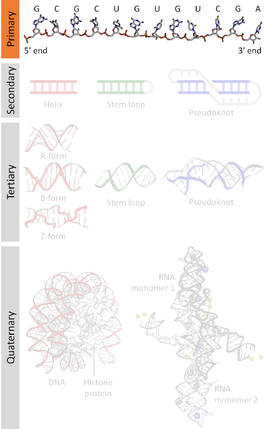
A nucleic acid sequence is a succession of bases signified by a serial of a set of five different letters that indicate the society of nucleotides forming alleles within a Dna (using GACT) or RNA (GACU) molecule. Past convention, sequences are unremarkably presented from the 5' end to the 3' cease. For Dna, the sense strand is used. Considering nucleic acids are commonly linear (unbranched) polymers, specifying the sequence is equivalent to defining the covalent construction of the entire molecule. For this reason, the nucleic acid sequence is besides termed the master structure.
The sequence has capacity to represent data. Biological dna represents the data which directs the functions of an organism.
Nucleic acids too have a secondary structure and tertiary structure. Primary construction is sometimes mistakenly referred to equally primary sequence. Conversely, there is no parallel concept of secondary or 3rd sequence.
Nucleotides [edit]
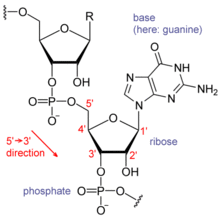
Chemical structure of RNA

A series of codons in part of a mRNA molecule. Each codon consists of three nucleotides, unremarkably representing a single amino acid.
Nucleic acids consist of a concatenation of linked units called nucleotides. Each nucleotide consists of three subunits: a phosphate group and a sugar (ribose in the instance of RNA, deoxyribose in Dna) brand upward the backbone of the nucleic acrid strand, and attached to the carbohydrate is one of a set of nucleobases. The nucleobases are important in base pairing of strands to form higher-level secondary and tertiary structure such as the famed double helix.
The possible messages are A, C, G, and T, representing the four nucleotide bases of a DNA strand – adenine, cytosine, guanine, thymine – covalently linked to a phosphodiester courage. In the typical case, the sequences are printed abutting one another without gaps, as in the sequence AAAGTCTGAC, read left to right in the 5' to 3' direction. With regards to transcription, a sequence is on the coding strand if it has the same order as the transcribed RNA.
One sequence can be complementary to another sequence, meaning that they have the base on each position in the complementary (i.e. A to T, C to G) and in the opposite order. For example, the complementary sequence to TTAC is GTAA. If one strand of the double-stranded Deoxyribonucleic acid is considered the sense strand, then the other strand, considered the antisense strand, will have the complementary sequence to the sense strand.
Notation [edit]
Comparing and determining % departure between two nucleotide sequences.
- AATCCGCTAG
- AAACCCTTAG
- Given the 2 10-nucleotide sequences, line them up and compare the differences between them. Calculate the percent similarity past taking the number of different DNA bases divided past the total number of nucleotides. In the above case, at that place are 3 differences in the 10 nucleotide sequence. Therefore, divide 7/10 to go the 70% similarity and subtract that from 100% to go a 30% divergence.
While A, T, C, and G represent a item nucleotide at a position, there are also letters that represent ambivalence which are used when more than than one kind of nucleotide could occur at that position. The rules of the International Union of Pure and Applied Chemical science (IUPAC) are as follows:[1]
| Symbol[ii] | Description | Bases represented | Complement | ||||
|---|---|---|---|---|---|---|---|
| A | Adenine | A | 1 | T | |||
| C | Cytosine | C | G | ||||
| G | Guanine | G | C | ||||
| T | Thymine | T | A | ||||
| U | Uracil | U | A | ||||
| W | Westwardeak | A | T | 2 | W | ||
| S | Strong | C | G | S | |||
| M | aGrandino | A | C | Chiliad | |||
| K | Geto | Chiliad | T | M | |||
| R | puRine | A | 1000 | Y | |||
| Y | pYrimidine | C | T | R | |||
| B | not A (B comes after A) | C | G | T | 3 | V | |
| D | non C (D comes later C) | A | Grand | T | H | ||
| H | not G (H comes after G) | A | C | T | D | ||
| V | non T (V comes after T and U) | A | C | One thousand | B | ||
| N | any Due northucleotide (not a gap) | A | C | G | T | 4 | Due north |
| Z | Zero | 0 | Z | ||||
These symbols are likewise valid for RNA, except with U (uracil) replacing T (thymine).[1]
Autonomously from adenine (A), cytosine (C), guanine (G), thymine (T) and uracil (U), Dna and RNA as well contain bases that have been modified after the nucleic acrid chain has been formed. In DNA, the most common modified base is 5-methylcytidine (m5C). In RNA, there are many modified bases, including pseudouridine (Ψ), dihydrouridine (D), inosine (I), ribothymidine (rT) and 7-methylguanosine (m7G).[3] [4] Hypoxanthine and xanthine are two of the many bases created through mutagen presence, both of them through deamination (replacement of the amine-grouping with a carbonyl-grouping). Hypoxanthine is produced from adenine, and xanthine is produced from guanine.[5] Similarly, deamination of cytosine results in uracil.
Biological significance [edit]
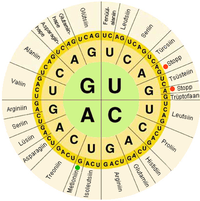
In biological systems, nucleic acids contain information which is used by a living cell to construct specific proteins. The sequence of nucleobases on a nucleic acid strand is translated by cell machinery into a sequence of amino acids making up a poly peptide strand. Each group of iii bases, called a codon, corresponds to a unmarried amino acid, and there is a specific genetic code by which each possible combination of three bases corresponds to a specific amino acid.
The central dogma of molecular biological science outlines the mechanism by which proteins are constructed using information contained in nucleic acids. Dna is transcribed into mRNA molecules, which travels to the ribosome where the mRNA is used as a template for the construction of the protein strand. Since nucleic acids tin bind to molecules with complementary sequences, there is a distinction between "sense" sequences which code for proteins, and the complementary "antisense" sequence which is by itself nonfunctional, only tin demark to the sense strand.
Sequence determination [edit]
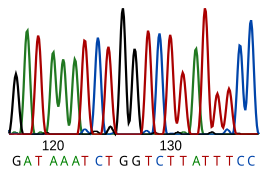
Electropherogram printout from automatic sequencer for determining part of a DNA sequence
DNA sequencing is the process of determining the nucleotide sequence of a given Deoxyribonucleic acid fragment. The sequence of the Dna of a living thing encodes the necessary information for that living matter to survive and reproduce. Therefore, determining the sequence is useful in fundamental enquiry into why and how organisms live, as well as in practical subjects. Because of the importance of Deoxyribonucleic acid to living things, knowledge of a Dna sequence may exist useful in practically any biological research. For case, in medicine it can exist used to identify, diagnose and potentially develop treatments for genetic diseases. Similarly, enquiry into pathogens may lead to treatments for contagious diseases. Biotechnology is a burgeoning discipline, with the potential for many useful products and services.
RNA is non sequenced directly. Instead, information technology is copied to a Deoxyribonucleic acid past reverse transcriptase, and this DNA is and so sequenced.
Current sequencing methods rely on the discriminatory ability of DNA polymerases, and therefore tin simply distinguish 4 bases. An inosine (created from adenosine during RNA editing) is read as a G, and v-methyl-cytosine (created from cytosine by Dna methylation) is read as a C. With current technology, it is hard to sequence pocket-size amounts of DNA, equally the betoken is too weak to mensurate. This is overcome by polymerase chain reaction (PCR) amplification.
Digital representation [edit]
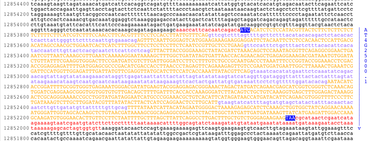
Genetic sequence in digital format.
In one case a nucleic acid sequence has been obtained from an organism, it is stored in silico in digital format. Digital genetic sequences may be stored in sequence databases, be analyzed (see Sequence analysis below), be digitally altered and be used equally templates for creating new actual Dna using artificial factor synthesis.
Sequence analysis [edit]
Digital genetic sequences may be analyzed using the tools of bioinformatics to attempt to determine its part.
Genetic testing [edit]
The DNA in an organism's genome tin be analyzed to diagnose vulnerabilities to inherited diseases, and tin can also be used to determine a kid's paternity (genetic begetter) or a person's ancestry. Normally, every person carries 2 variations of every factor, one inherited from their mother, the other inherited from their father. The human genome is believed to contain effectually xx,000–25,000 genes. In addition to studying chromosomes to the level of individual genes, genetic testing in a broader sense includes biochemical tests for the possible presence of genetic diseases, or mutant forms of genes associated with increased hazard of developing genetic disorders.
Genetic testing identifies changes in chromosomes, genes, or proteins.[half-dozen] Normally, testing is used to find changes that are associated with inherited disorders. The results of a genetic examination can confirm or rule out a suspected genetic condition or help determine a person'due south chance of developing or passing on a genetic disorder. Several hundred genetic tests are currently in use, and more are being adult.[7] [8]
Sequence alignment [edit]
In bioinformatics, a sequence alignment is a way of arranging the sequences of Dna, RNA, or protein to identify regions of similarity that may be due to functional, structural, or evolutionary relationships betwixt the sequences.[9] If two sequences in an alignment share a mutual ancestor, mismatches tin can be interpreted as point mutations and gaps as insertion or deletion mutations (indels) introduced in one or both lineages in the time since they diverged from one some other. In sequence alignments of proteins, the degree of similarity betwixt amino acids occupying a particular position in the sequence tin be interpreted as a rough measure out of how conserved a particular region or sequence motif is amongst lineages. The absenteeism of substitutions, or the presence of only very conservative substitutions (that is, the exchange of amino acids whose side chains have similar biochemical properties) in a particular region of the sequence, propose[x] that this region has structural or functional importance. Although DNA and RNA nucleotide bases are more similar to each other than are amino acids, the conservation of base of operations pairs can indicate a similar functional or structural role.[11]
Computational phylogenetics makes extensive apply of sequence alignments in the construction and interpretation of phylogenetic trees, which are used to allocate the evolutionary relationships between homologous genes represented in the genomes of divergent species. The caste to which sequences in a query set up differ is qualitatively related to the sequences' evolutionary altitude from one another. Roughly speaking, high sequence identity suggests that the sequences in question take a comparatively immature most recent common ancestor, while low identity suggests that the divergence is more ancient. This approximation, which reflects the "molecular clock" hypothesis that a roughly constant charge per unit of evolutionary modify can be used to extrapolate the elapsed time since two genes first diverged (that is, the coalescence time), assumes that the effects of mutation and pick are constant across sequence lineages. Therefore, information technology does non account for possible departure among organisms or species in the rates of Deoxyribonucleic acid repair or the possible functional conservation of specific regions in a sequence. (In the instance of nucleotide sequences, the molecular clock hypothesis in its well-nigh basic class as well discounts the difference in credence rates between silent mutations that practice not alter the meaning of a given codon and other mutations that issue in a different amino acid being incorporated into the protein.) More than statistically authentic methods let the evolutionary rate on each co-operative of the phylogenetic tree to vary, thus producing better estimates of coalescence times for genes.
Sequence motifs [edit]
Frequently the master structure encodes motifs that are of functional importance. Some examples of sequence motifs are: the C/D[12] and H/ACA boxes[13] of snoRNAs, Sm bounden site constitute in spliceosomal RNAs such as U1, U2, U4, U5, U6, U12 and U3, the Shine-Dalgarno sequence,[14] the Kozak consensus sequence[fifteen] and the RNA polymerase III terminator.[sixteen]
Sequence entropy [edit]
In bioinformatics, a sequence entropy, as well known as sequence complication or information profile,[17] is a numerical sequence providing a quantitative measure of the local complexity of a DNA sequence, independently of the direction of processing. The manipulations of the information profiles enable the analysis of the sequences using alignment-complimentary techniques, such as for example in motif and rearrangements detection.[17] [18] [19]
Meet also [edit]
- Cistron structure
- Nucleic acid construction determination
- 4th numeral system
- Unmarried-nucleotide polymorphism (SNP)
References [edit]
- ^ a b Nomenclature for Incompletely Specified Bases in Nucleic Acrid Sequences, NC-IUB, 1984.
- ^ Classification Commission of the International Union of Biochemistry (NC-IUB) (1984). "Nomenclature for Incompletely Specified Bases in Nucleic Acid Sequences". Retrieved 2008-02-04 .
- ^ "BIOL2060: Translation". mun.ca.
- ^ "Research". uw.edu.pl.
- ^ Nguyen, T; Brunson, D; Crespi, C L; Penman, B W; Wishnok, J S; Tannenbaum, S R (April 1992). "Deoxyribonucleic acid harm and mutation in human cells exposed to nitric oxide in vitro". Proc Natl Acad Sci United states of america. 89 (7): 3030–034. Bibcode:1992PNAS...89.3030N. doi:10.1073/pnas.89.seven.3030. PMC48797. PMID 1557408.
- ^ "What is genetic testing?". Genetics Habitation Reference. 16 March 2015. Archived from the original on 29 May 2006. Retrieved 19 May 2010.
- ^ "Genetic Testing". nih.gov.
- ^ "Definitions of Genetic Testing". Definitions of Genetic Testing (Jorge Sequeiros and Bárbara Guimarães). EuroGentest Network of Excellence Project. 2008-09-11. Archived from the original on February four, 2009. Retrieved 2008-08-10 .
- ^ Mountain DM. (2004). Bioinformatics: Sequence and Genome Analysis (second ed.). Cold Spring Harbor Laboratory Printing: Common cold Spring Harbor, NY. ISBN0-87969-608-vii.
- ^ Ng, P. C.; Henikoff, S. (2001). "Predicting Deleterious Amino Acid Substitutions". Genome Research. 11 (v): 863–74. doi:10.1101/gr.176601. PMC311071. PMID 11337480.
- ^ Witzany, G (2016). "Crucial steps to life: From chemical reactions to lawmaking using agents". Biosystems. 140: 49–57. doi:10.1016/j.biosystems.2015.12.007. PMID 26723230.
- ^ Samarsky, DA; Fournier MJ; Singer RH; Bertrand East (1998). "The snoRNA box C/D motif directs nucleolar targeting and also couples snoRNA synthesis and localization". The EMBO Journal. 17 (13): 3747–57. doi:ten.1093/emboj/17.13.3747. PMC1170710. PMID 9649444.
- ^ Ganot, Philippe; Caizergues-Ferrer, Michèle; Kiss, Tamás (1 Apr 1997). "The family unit of box ACA small nucleolar RNAs is defined by an evolutionarily conserved secondary structure and ubiquitous sequence elements essential for RNA aggregating". Genes & Development. 11 (7): 941–56. doi:ten.1101/gad.11.7.941. PMID 9106664.
- ^ Smoothen J, Dalgarno 50 (1975). "Determinant of cistron specificity in bacterial ribosomes". Nature. 254 (5495): 34–38. Bibcode:1975Natur.254...34S. doi:ten.1038/254034a0. PMID 803646. S2CID 4162567.
- ^ Kozak Thou (October 1987). "An analysis of 5'-noncoding sequences from 699 vertebrate messenger RNAs". Nucleic Acids Res. 15 (xx): 8125–48. doi:x.1093/nar/fifteen.20.8125. PMC306349. PMID 3313277.
- ^ Bogenhagen DF, Brownish DD (1981). "Nucleotide sequences in Xenopus 5S Deoxyribonucleic acid required for transcription termination". Cell. 24 (1): 261–seventy. doi:10.1016/0092-8674(81)90522-5. PMID 6263489. S2CID 9982829.
- ^ a b Pinho, A; Garcia, S; Pratas, D; Ferreira, P (Nov 21, 2013). "DNA Sequences at a Glance". PLOS ONE. eight (xi): e79922. Bibcode:2013PLoSO...879922P. doi:ten.1371/journal.pone.0079922. PMC3836782. PMID 24278218.
- ^ Pratas, D; Silva, R; Pinho, A; Ferreira, P (May 18, 2015). "An alignment-gratis method to find and visualise rearrangements between pairs of DNA sequences". Scientific Reports. five: 10203. Bibcode:2015NatSR...510203P. doi:10.1038/srep10203. PMC4434998. PMID 25984837.
- ^ Troyanskaya, O; Arbell, O; Koren, Y; Landau, M; Bolshoy, A (2002). "Sequence complexity profiles of prokaryotic genomic sequences: A fast algorithm for calculating linguistic complication". Bioinformatics. xviii (five): 679–88. doi:10.1093/bioinformatics/xviii.v.679. PMID 12050064.
External links [edit]
- A bibliography on features, patterns, correlations in Deoxyribonucleic acid and protein texts
Source: https://en.wikipedia.org/wiki/Nucleic_acid_sequence
Posted by: davisgostain.blogspot.com
0 Response to "How To Make A Youtube Title Sequence"
Post a Comment